
FRAN FLAHERTY

Photograph of Fran Flaherty smiling, wearing dark glasses, earth-toned scarf, and balck shirt with shoulder length dark hair and gold circlet earrings. Photography by Kitoko Chargois.
Fran Flaherty is the creator of Anthropology of Motherhood and a deaf artist living in Pittsburgh for over 25 years. As a first generation immigrant from the Philippines, her work is centered on issues surrounding migrant family relations and assimilation, maternal feminism, disability aesthetics, and social work. Her work is inspired by the care paradigm. A premise that human beings cannot survive alone and the progress of human beings, as a species, flows from our identity as social animals, connected to one another through ties of love, kinship, and clanship. It is the prospect of this harmony that inspired her to create Anthropology of Motherhood, an ongoing project which elevates the act of care-giving through fine art by transforming mundane objects of caregiving into valuable art pieces such as paintings, sculpture, and mixed media pieces. She also transforms busy public spaces into immersive installations that serve as places of respite for young children and their caregivers and is a member of the #notwhite collective. Recently, she was named in Art 511 Magazine’s “Top Ten NYC Artists Now”. Fran currently resides in Allison Park with her husband Tim, their sons, Liam, Sean, and Lucas, and her hearing dog Olympia. Her most recent work can be found at Zhou B Center in Chicago, Illinois, Dyers Art Center in Rochester, NY, and Carlow University Art Gallery, Pittsburgh, PA.
“This collection reflects my lived experience as a Deaf individual. The painted phrases are drawn from comments I hear frequently— remarks that minimize or question my deafness because it does not conform to common expectations of what disability looks like.
While rooted in personal experience, the series extends beyond autobiography. The central work reframes disability not as an individual condition to be explained or defended, but as something shaped by social attitudes and structures. Across six canvases, the work invites viewers to consider how ableism functions as a collective responsibility, embedded in cultural assumptions rather than in the body itself. ”
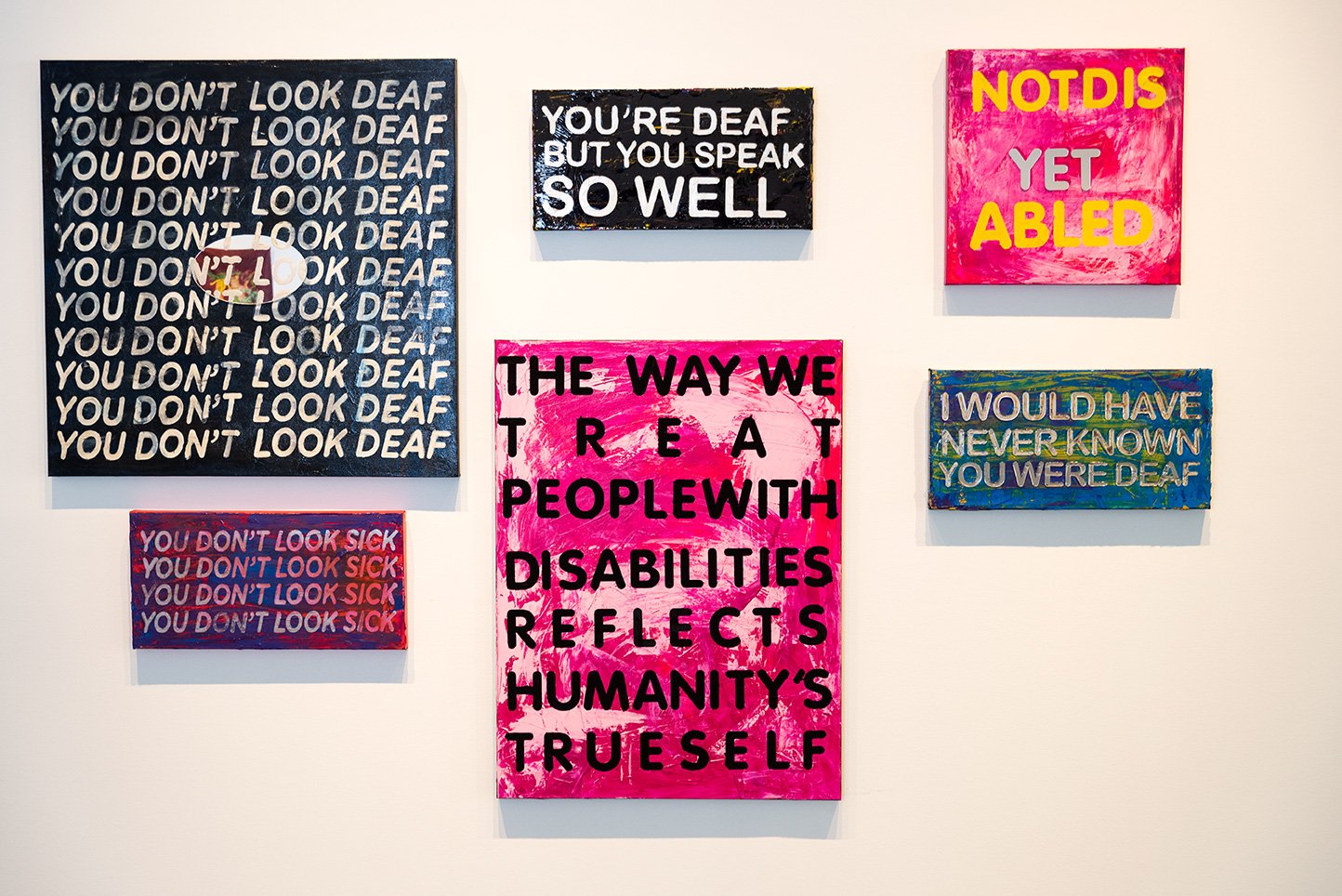
Clockwise from top left:
You don’t look deaf, Acrylic on canvas, 36 x 36 inches, 2020, $600
You’re deaf? But you speak so well, Acrylic on canvas, 24 x 12 inches, 2022, $400
Not yet, Acrylic on canvas, 20 x 20 inches, 2022, $600
I would have never known that you were deaf, Acrylic on canvas, 24 x 12 inches, 2022, $400
The way, Acrylic on canvas, 30 x 40 inches, 2022, $700
You don’t look sick, Acrylic on canvas, 24 x 12 inches, 2022, $400
Image Descriptions:
You don’t look deaf - Black square painted canvas with “You don’t look deaf” in slanted all capitalized bold white letters in a repeating pattern, each line being the whole phrase, repeating down to the bottom of the canvas. In the middle of the canvas is an oval mirror which invites the viewer to contemplate this phrase while seeing their own reflection.
You’re deaf? But you speak so well - Black rectangular painted canvas with capitalized, bold letters in white reading “You’re Deaf” on the first line; “But you speak” on the second; and “So well” on the third, with the third line’s letters being in a larger size to help the phrase hit harder.
Not yet - Hot pink square painted canvas with capitalized bold letters in yellow reading “NotDis” on the first line, “Yet” on the second in reflective mirror-material; and “Abled” in yellow on the bottom line.
I would have never known that you were deaf - Dark blue and green rectangular painted canvas with capitalized bold letters in transparent acrylic material reading “I would have” on the first line; “never known” on the second line,” and “you were deaf” on the bottom line.
The way - Hot pink painted rectangular canvas with textured strokes of lighter pink. Capitalized bold black letters read “The way we” on the first line, “T R E A T” on the second line; “people with” on the third line; “disabilities” on the fourth line; “R E F L E C T S” on the fifth line; “humanity’s on the sixth line; and “T R U E S E L F” on the bottom line.
You don’t look sick - Dark blue and orange painted rectangular canvas with “You don’t look sick” in capitalized bold white letters.