
LAURA LEE McCARTNEY

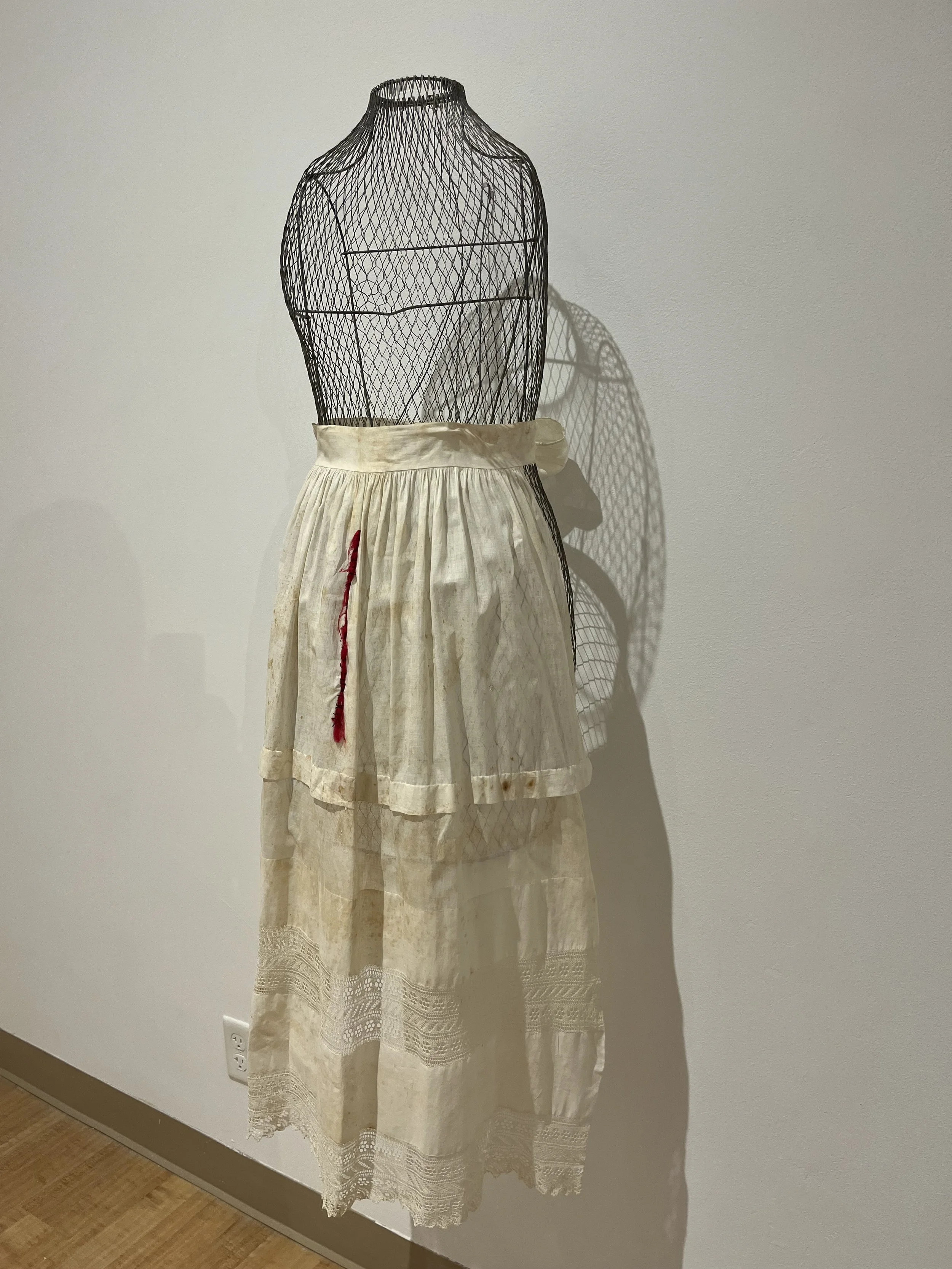

Apron Strings, Vintage apron, mixed fibers, wire form, 23.5 x 50 inches, 2016.
I explore spaces to unravel moments of caring and “uncaring” for the things we hand down as mothers and daughters. For this piece, I turned to my great-grandmother’s apron that was saved in an old family trunk for over a century. Originally, I thought this piece was not significant or worthy to keep or display because of the many ways it had not been cared for—it was stained, ripped and covered in moth holes. However, I was able to reconsider family threads I inherited and use them as sites to remember and feel my own preservation and decay. The apron became a site for me to cut, rip, tear, and “uncare” in order to better care for self in my story of becoming. My daughter was born under great distress in an emergency caesarian delivery at 25 weeks old—weighing only 1 pound, 11 ounces. Much like this old apron packed into a trunk, I had packed my pain away so I would not retrace or relive the trauma. I was able to reimagine the scar tissue of my soul in new ways. I measured the length of the scar I still carry on my abdomen from the day I was literally opened into motherhood and caregiving. I laid a large red thread down the front of my great-grandmother’s apron to mark the distance and the wound on the fabric. I used vintage black thread from my great-grandmother’s sewing basket to stitch traces of the 37 staples that were used to secure my incision. I frayed the red wool in between and in-between the stitches, undoing its edges. I opened myself one-stitch at a time. Finally free. I ran my hand over the fibers, and thought about the ways apron strings can be used for other things.
Laura Lee McCartney, PhD is a curator, artist, researcher, teacher and mother who currently works as an Assistant Professor of Art Education at Texas Woman’s University. McCartney has worked as a museum curator and has taught elementary, middle and high school art in public schools in North Texas. Her work resides in the tension between caring for objects and ideas with caring for loved ones, visitors, and students. McCartney’s arts-based research uses feminist poststructuralist and performativity theory to allow for unpacking curator and caregiver identity constructions within art education through thick autobiographical narrative—namely remembrance of wounds, of grief, of fragility, of pain. Within these spaces of hurt, there are moments to feel and re-find our way. In her work, McCartney explores opportunities for deconstructing material culture as a means to trouble the practices of caring, collecting, keeping, hoarding, creating, and curating as living curricula and pedagogies within art education.